BOOK CHANGES - Page I of 2
Sign up to hear from us about specials, sales, and events.
Ready to take the next step?
Join us and discover what we can do for you.

1. Srila Prabhupada's - Free Press
If Prabhupāda’s original words are sacred, then why change?
No previous ācārya’s books were treated like this after their departure.
No tradition in the paramparā legitimizes post-samādhi revisions.
And no devotee can ignore this once they actually see the changes.
GITA COVER-UP OR BUYER BEWARE!
BBT is not the original book trust; it is a corporation calling Srila Prabhupada author for hire.
By Rupanuga Dasa (ACBSP)
Interested parties should be made aware that the BBT editors of Srila Prabhupada’s Bhagavad-gita As It Is have continued editing their own new (2010) paperback edition of their 1983 “revised and enlarged” version. They have removed the notice “Revised and Enlarged” from the face page and left only “Second Edition.” The phrase “with the original Sanskrit text, Roman transliteration, English equivalents, translation and elaborate purports” has been omitted. So now, after all the omissions, the face page reads simply “Bhagavad-Gita As It Is, Second Edition, by His Divine Grace A.C. Bhaktivedanta Swami Prabhupada.”
Consequently, there is no indication for the prospective buyer that the book is actually a revised version of the original; rather it is made to appear to be simply a re-printing of the original—by the same author! The BBT editors, remaining incognito, continue to plagiarize Srila Prabhupada’s name and fame to lend credibility to their in fact re-written version of the Bhagavad-Gita As It Is, originally designated as the “Complete Edition” by Srila Prabhupada himself.
On the back cover, once again the editors omit an important phrase in the description of Srila Prabhupada as “the leading exponent of the science of Krsna consciousness in the West and the world’s most distinguished teacher of Vedic religion and thought…” And they add a curious sentence in conclusion, which really reflects their own clandestine position: “Thus, unlike other editions of the Gita, his conveys Lord Krsna’s profound message as it is—without the slightest taint of adulteration or personally motivated change.” This is so reminiscent of that well-known story of the man on the second floor of his house hearing a noise downstairs and calling out, “Who’s there?” revealing the actual position, a voice from below answers emphatically, “Oh, I’m not stealing! I’m not stealing!”
Or the time when devotees told Srila Prabhupada about a newspaper article claiming that a space probe to Mars had sent back photographic images that so closely resembled the terrain in Arizona. Srila Prabhupada said the scientists involved were themselves in Arizona, simply revealing their own minds, reflecting their surroundings.
Similarly, these editors, perhaps smarting from unending legitimate criticism, have inadvertently revealed their own position: “Oh no, we have edited responsibly, without the slightest taint of adulteration or personally motivated change!” But they continue to commit what Srila Prabhupada described in the purport Srimad Bhagavatam 3.4.26:
“Although one may be well versed in transcendental science, one should be careful
about the offense of maryada-vyatikrama, impertinently surpassing a greater personality.”
The impertinence knows no bounds, because BBT editing has become a co-authoring of Srila Prabhupada’s books. Buyer beware! Milk still looks like milk even when containing poison.

BOOK CHANGES
"clearly not the same book"..."unreliable for the study of Srila Prabhupada's teachings"
"A Scientific Method for Evaluating Editorial Changes to Srila Prabhupada's Books"
By Rupanuga das & Krsna Krpa dasi
September 10, 2008
"Our editing is to correct grammatical and spelling errors only, without interpolation of style or philosophy." (Letter to Rupanuga, 2/17/70) Previous evaluations of the editorial changes focused on descriptions of the changes and references to pre-publication drafts rather than a factual quantification and comparative philosophical analysis. This article presents a scientific evaluation of the Bhagavad-gita As It Is and the Teachings of Lord Caitanya. The results demonstrate if the revised editions followed Srila Prabhupada's editorial policy and if they are genuine, authentic revisions that preserve the original content, philosophy and style.
Two Editions of TLC Compared
The 1968 original edition of the Teachings of Lord Caitanya (TLC) was last printed by BBT in 1972. Its content and words are substantially different from the 1974 BBT (USA) edition and subsequent revisions. Over 100 pages of the 1968 first printing and the 1974 edition were compared. Nearly 12,000 words were deleted from one third of the first edition, equivalent of 24 full pages of text. At this rate, the total number of deleted words for the entire book is estimated at 33,000, the equvalent of 66 full pages of text missing from a book 310 pages long. Substantial information and philosophy was deleted along with the thousands of words. Clearly, the 1968 original edition contains substantial content not found in the 1974 edition and subsequent revisions.
Method of Counting Deleted Words
How were deleted words determined? The 1968 and 1974 editions were compared word for word, sentence by sentence. Words that appeared in the first edition but were deleted (omitted) from the 1974 edition were marked as deleted words. Great care was taken not to count words that were rearranged in the same sentence or which appeared in another nearby sentence or paragraph. Words that were changed for spelling, capitalization or punctuation were not counted as deleted words. Words for citation references that were changed to the standard format were not counted as deleted words. In the following example, none of the words were counted as deleted words:
1968: Srimad Bhagawatam, Tenth Canto, Ninth Chapter, 12th Verse
1974: SB, 10.9.12
Deleted words were counted whether or not the words were replaced by other words. In the following example, the words "you" and "I" were counted as deleted from the first edition even though they were replaced by substitutes in the 1974 edition.
"It is not displayed by you or I" (1968, p.1)
"It is not displayed by man or any other creature." (1974, p.1)
Results for TLC
The results were extensive. In 112 pages, 11,831 words were deleted. In the Introduction alone, 3,695 words were deleted from 18 pages, the equivalent of 7.4 full pages of text. Approximately 40% of the total words were deleted from the Introduction. In the paragraph describing the ten offenses to the Holy Name, 218 words were deleted out of 524 total words, meaning 42% of the words in this paragraph were deleted (from 1968, p. 27-28).
Analysis of the content of Deleted and Inserted Words
The content of deleted words ws examined. Many deleted phrases, sentences and paragraphs contained information, standards and philosophy that were not rewritten or relocated in the 1974 edition, i.e., they were deleted completely from the book. The following are examples of deleted information, standards and philosophy; the deleted words are in bold type.
Examples of deleted information include:
1. "Other devotees had approached Chaitanya and asked Him to forgive Junior Haridas, but Chaitanya replied, 'You all go live with him and forgive him. I'll stay alone." (1968, p. 3)
2. "...Brahma created the whole human society, animal society, everything." (1968, p. 14)
Examples of deleted standards include:
1. "...one should not eat anything other than Krishna prasadam (food offered to Krishna)." (1968, p.28)Compare with the 1974 version: "One should not indulge in illicit sex life, intoxication, meat eating or gambling." (1974, p.30)
2. "...but He [Lord Caitanya] was strict -- like a thunderbolt -- with those of the renounced order who cheated by the method known as 'drinking water underwater while taking bath on a fast day.'" (1968, p. 3)
Examples of deleted philosophy include:
1. "Therefore to learn how Krishna's pleasure can be obtained, you have to study the first Nine Cantos of Srimad Bhagwatam. In the Tenth Canto, Krishna's pleasure potency is displayed... (1968, p. 8)Compare with the 1974 version which inserted sahajiyism: "In order to learn how pleasure can be obtained, we must read the Tenth Canto of Srimad-Bhagwatam in which Krsna's pleasure potency is displayed..." (1974, p. 11)
2. "If one is unnecessarily envious of a devotee who is trying to spread the Holy Name all over the world, in execution of the order of his spiritual master, such a rascal is the greatest offender at the Feet of the Holy Name." (1968, p.27)
3. "But Krishna Consciousness is so nice that it makes no distinction between man and woman." (1968, p. 7)
4. Vedic astronomy was replaced with Western astronomy by the insertion of three words. "the earth about":"Lord Caitanya gave a comparable instance in the orbit of the Sun." (1968, p. 80)"Lord Caitanya clarified this by comparing His pastimes to the orbit of the earth about the sun." (1974, p.93, italics added)
Examples of deleted logic and reasoning.
Another category of deletions is logic and reasoning. In the 112 pages of the TLC so far examined, the word "therefore" was omitted 66 times from the 1968 edition. Most often, "therefore" was replaced with "since" or "because," but in 27 instances, "therefore" was not replaced at all.
In Los Angeles, August 25, 1972 morning lecture, Srila Prabhupada explained his use of the word "therefore":
So, "therefore," the word is "therefore." "Therefore" means after concluding something. That means the "therefore." When you talk, when you argue, when you come to the conclusion, then you say "therefore." Or when our argument is stopped, then we say "therefore."
In other words, Srila Prabhupada used this word to speak and write conclusive and convincing statements. He used "therefore" to emphasize and make certain points so that the reader would use his own logic and reasoning to accept them. Srila Prabhupada's use of "therefore" is opposed to dogmatic statements which are written in a style of factual statements.
In addition to the deletions discussed above, the following items were omitted from the revised edition:
* The book's subtitle: "A Treatise on Factual Spiritual Life"
* The division of chapters into Part I and Part II (see Table of Contents)
* Publisher's note
* Acknowledgement page
* The author's biography, and
* Black and white illustrations
Two Editions of Bhagavad-gita Compared: A Preliminary Study
The same method of count and analyze was applied to Srila Prabhupada's 1972 original complete edition of Bhagavad-gita As It Is and the revised 1983 version. Only the verse translations were examined. Out of the total 700 verses, in 74% or 521 verses, the words were changed by deletions, or rearrangement. In three chapters, over 90% of the verses were changed in this way. Chapter 6 had 43 verses changed out of 47 total; Chapter 11 had 50 out of 55; and Chapter 17 had 26 out of 28. (These numbers do not include verses that were changed only for spelling, punctuation or capitalization. Only 21 verses, or 3% of the total, are in this category.)
Chapters 1-3, 6, 11 and 18, which contain 49% or 341 of the total 700 verses, were carefully examined to count the number of deleted words. Of the 341 verses, 227 contained deletions totaling 987 words. 215 verses contained inserted words (which have not been counted yet). Since nearly 1000 words were deleted from half of the Gita verses examined, it is estimated that at least 2000 words were deleted from the verses alone in the 1983 revised edition.
Analysis of the deleted, inserted and re-arranged words in the revised edition revealed philosophical interpolations, that is, the insertion of different ideas. For example, regarding sense control, "control the lower self by the higher self" (1972, Bg 3.43) was interpolated to "steady the mind by deliberate spiritual intelligence" (1983); and "he who controls the senses" (1972, Bg 3.7) was interpolated to "a sincere person who tries to control the active senses" (1983); and "You are the origin without beginning, middle or end" to "You are without origin, middle or end" (Bg 11.19); and "out of fear" to "out of fear of bodily discomfort" (Bg 18.8).
In another example, the word "eternal" was deleted from the revised translation, although the Sanskrit word "nitya" (meaning "eternal") is included in the Sanskrit verse: "he who dwells in this body is eternal and can never be slain" (1972, Bg 2.30) changed to "he who dwells in this body can never be slain" (1983).
Other philosophical changes were made by replacing words (indicated in bold type). For example: "One who is not in transcendental consciousness" (1972, Bg 2.66) was changed to "One who is not connected with the Supreme [in Krsna consciousness]" (1983); and "all material desires born of false ego" (1972, Bg 6.24) changed to "all material desires born of mental speculation" (1983)
The revised edition altered the meaning of numerous verses simply by substituting words that are not synonymous. The dictionary definitions of the substitutions differ substantially from the original edition words. For example: "the self-realized soul" (1972, Bg 2.13) was changed to "a sober person" (1983); "coward" to "insignificant" (Bg 2.35); "constant practice" to "suitable practice" (Bg 6.35); "master" to "creator" (Bg 11.37); "right means" to "appropriate means" (Bg 6.36); "deviated" to "bewildered" (Bg 6.38); "factors" to "causes" (Bg 18.13); "threefold basis" to "three constituents" (Bg 18.18); "ignorance and delusion" to "illusion" (Bg 18.25); "corrupt" to "polluted" (Bg 1.40); "one who has been honored" to "a respectable person" (Bg 2.34); "fruitive activities" to "abominable activities" (Bg 2.49); "truly situated in knowledge" to "firmly fixed in perfect consciousness" (Bg 2.58); "impulses" to "qualities" (Bg 3.5); "nourishing" to "cooperation" (Bg 3.11); "work" to "prescribed duties" (Bg 3.22); "sentient beings" to "living beings" (Bg 3.24); "fruitive action" to "fruitive results" (Bg 3.26); "influence of the three modes" to "influence of false ego" (Bg 3.27); "doomed to ignorance and bondage" to "ruined in their endeavors for perfection" (Bg 3.32)
Some revisions changed the meaning of the verses by replacing or rearranging many words. For example: "though I may survive" (1972, Bg 1.32-35); changed to "though they might otherwise kill me" (1983); "Attraction and repulsion for sense objects are felt by embodied beings, but one shall not fall under the control of senses and sense objects." (1972, Bg 3.34); was replaced by "There are principles to regulate attachment and aversion pertaining to the senses and their sense objects. One should not come under the control of such attachment and aversion." (1983). And "One can obtain the results of renunciation simply by self-control and by becoming unattached to material things and disregarding material enjoyments. That is the highest perfectional stage of renunciation." (1972, Bg 18.49) was replaced by "One who is self-controlled and unattached and who disregards all material enjoyments can obtain, by practice of renunciation, the highest perfect stage of freedom from reaction." (1983).
Additional philosophical changes were made by removing logic and reasoning. For example, in one verse (Bg 2.64), the word "thus" was deleted and words were rearranged. The result was that the revised edition reversed the process, thereby changing the cause into the effect, and the effect into the cause. "One who can control his senses by practicing the regulated principles of freedom can obtain the complete mercy of the Lord and thus become free from all attachment and aversion." (1972, Bg 2.64) changed to "But a person free from all attachment and aversion and able to control his senses through regulative principles of the Lord can obtain the complete mercy of the Lord." (1983, Bg 2.64)
Logic and reasoning was removed from some verses by rearranging or replacing critical words. In logical arguments, certain words such as "similarly," "therefore," "if," and "then" indicate conclusions or how to apply reason within the argument. Different grammatical rules are used in logical arguments. For example, in a logical argument, the word "similarly" is placed as the first word to identify the beginning of a conclusive statement. In factual or descriptive statements, the word is used simply as an adverb and placed in a different location, near the verb. In several verses, the revised edition moved the word "similarly" to make it act as an adverb rather than to identify the conclusion. Consequently, the original philosophical conclusion was changed to a weaker, descriptive statement.
Original Complete edition: "As a person puts on new garments, giving up old ones, similarly, the soul accepts new material bodies, giving up old and useless ones." (1972, Bg 2.22)
Second edition: "As a person puts on new garments, giving up old ones, the soul similarly accepts new material bodies, giving up the old and useless ones." (1983, Bg 2.22)
Srila Prabhupada's poetic, often epic, style was interpolated frequently and replaced by a conventional, news magazine style. For example, "subject to destruction" (1972, Bg 2.18) changed to "sure to come to an end" (1983); "behold" to "see now" (Bg 11.5); "there is no end, there is no beginning, and there is no middle to all of this" to "no end, no middle, and no beginning" (Bg 11.16); "who stands above even Brahma" to "greater even than Brahma" (Bg 11.37); and "homage" to "respectful obeisances" (Bg 11.37).
Interpolations of style also include the replacement of original complete edition words with synonyms. Such changes did not clarify the meaning or correct grammatical errors. For example, "happiness and distress" (1972, Bg 18.27) change to "joy and sorrow" (1983); "listen" to "hear" (Bg 18.20); "a man" to "a person" (Bg 3.16); "sea" to "ocean" (Bg 11.5); "one who is engaged" to "he who engages" (Bg 11.55); and "in accordance with" to " according to" (Bg 18.19).
In some verses, words were arbitrarily rearranged; for example, "ignorance and illusion" (1972, Bg 18.72) changed to "illusion and ignorance" (1983).
In other verses, the commanding, imperative, forceful style suitable for giving orders was changed to a weaker style, more suitable for suggestions. For example, "Be steadfast in yoga, O Arjuna. Perform your duty and abandon all attachment to success or failure. Such evenness of mind is called yoga." (1972, Bg 2.48) changed to "Perform your duty equipoised, O Arjuna, abandoning all attachment to success or failure. Such equanimity is called yoga." (1983).
In summary, it is estimated that over 2000 words were deleted from the verse translations alone in Srila Prabhupada's original complete edition of Bhagavad-gita and that words were inserted in over half of the total verses. It seems that the revised Gita changed the majority of Srila Prabhupada's translated verses, including philosophy and style. Further investigation is required. In any case, this preliminary study has demonstrated that the revised edition is clearly not the same book.
Conclusion
The count and analysis method produced evidence that conclusively proves that the revised editions of Bhagavad-gita As It Is and the Teachings of Lord Caitanya are not editorially equivalent to the first editions in philosophy, style or content. These revised editions contain an undetermined number of interpolations of philosophy and style. Some examples have been demonstrated herein. These revised editions mix Srila Prabhupada's teachings with different ideas without separating (or identifying) one from the other. Thus, for the general reader, it is difficult to identify the interpolations of philosophy and style within the revised editions. For this reason alone, the revised editions of the Bhagavad-gita As It Is and the Teachings of Lord Caitanya are unreliable for the study of Srila Prabhupada's teachings.
TLC/BgAII
EXCERPTS:
"Our editing is to correct grammatical and spelling errors only, without interpolation of style or philosophy." Srila Prabhupada
TLC: "Nearly 12,000 words were [found to be] deleted from one third of the original first editin, the equivalent of 24 full pages of text. At this rate, the total number of deleted words for the entire book is estimated at 33,000, the equivalent of 66 full pages of text missing from a book 310 pages long."
TLC: "Substantial information and philosophy was deleted along with the thousands of words."
GITA: "It is estimated that over 2000 words were deleted from the verse translations alone."
GITA: "...the revised Gita changed the majority of Srila Prabhupada's translated verses, including philosophy and style."
GITA: "This preliminary study has demonstrated that the revised edition is clearly not the same book."
"One should be careful about the offense of maryavada-vyati"
ORIGINAL COMPLETE EDITION: "a success...standard edition for scholars...around the world."
"Where Angels Fear to Tread"
BY: RUPANUGA DAS ACBSP
The editors of the 1983 revised Gita did not believe that they actually interpolated philosophy or style.* Their idea was to improve both translations and purports by transposing clarifying portions of old manuscripts, etc. existing prior to the one finally submitted to Macmillan in 1972. ...
...Srila Prabhupada never instructed anyone to use a procedure of re-visiting and researching old manuscripts or dictations to revise future printings of his first editions. On the other hand, recordings made from 1972 until 1977, six years, demonstrate how Srila Prabhupada often personally read excerpts from the Gita in classes, room conversations, engagements, etc. Many times he also instructed devotees present to read aloud as he listened. There is no evidence indicating that he ordered extensive revisions for the next printing. As the current chief editor wrote; "To my knowledge, Srila Prabhupada never asked us to re-edit the book." (letter to Amogha Lila, July, 1986).
Interestingly enough, none of the scholars, educators, professors and other reviewers of the Gita called for it either. From 1972 until 1977 we don't find requests from professionals for a revision to a higher standard. Nor do we hear any demand from devotees in general for such a thorough revision. In fact, the editors state in "A Note About the Second Edition" found in the BBT revised editions: "Yet their effort to publish Srila Prabhupada's work was a success, and the Bhagavad-gita As It Is has become the standard edition for scholars and devotees around the world." Still, after eleven years of documented success, the Gita was extensively re-worked. Why? What is the reason?
The editors continue their explanation: "For this second edition, however, Srila Prabhupada's disciples had the benefit of having worked with his books for the last fifteen years. The English editors were familiar with his philosophy and language, and the Sanskrit editors were by now accomplished scholars. And now they were able to see their way through perplexities in the manuscript by consulting the same Sanskrit commentaries Srila Prabhupada consulted when writing Bhagavad-gita As It Is. The result is a work of even greater richness and authenticity... In places the translations, though already correct, have been revised to come closer to the original Sanskrit and Srila Prabhupada's original dictations..." **
The editors are claiming the benefit of 15 years of work, which would mean 1968 until 1983, the year of the revision. However, the value of those benefits is uncertain, bwecause in June, 1977 Srila Prabhupada severely chastised the editors for changes to his Isopanisad and Bhagavatam. He described the editors as rascals (a term he usually reserved for atheists, material scientists and politicians), and called them "dangerous" at least six times in ten minutes of discussion. Just five months before his disappearance, Srila Prabhupada made this a major issue for the Society. And his solution for the editorial rascaldom to the book in question was to 'go back to the original printing', thus setting a precedent.
The same basic issue came up in 1983 and has continued more or less for the last 25 years. But for us, now, who will decide who is right and who is wrong? One side says "responsible editing;" the other says "irresponsible, unauthorized, etc." But who is right and who is wrong? Who will decide?
So now we must come to the point of reason. Is it reasonable to conclude that just five or six years after deserving that 1977 chastisement, editors could have emerged as "accomplished scholars" --by 1983? One editor escaped chastisement. Still, isn't six years a short time for everyone to turn up as "accomplished scholars?" But even if all the editors had been studying superexcellent depths of Sanskrit revelation, and come up with an understanding of its complexities** ---the same complexities understood by previous acaryas? Was this the prerogative of such disciples, that they could be "able to see their way through perplexities in the manuscript by consulting the same Sanskrit commentaries Srila Prabhupada consulted when writing the Bhagavad-gita As It Is? Is it possible? It's ridiculous to even consider.
And further, "In places the translations, though already correct, have been revised to come closer to the original Sanskrit..." Here the implication is that the editors in 1983, whoever they were, thought they could interpret the original Sanskrit texts comparatively as well as Srila Prabhupada himself --or better?-- or at least well enough to put their new realizations in his book under his name. And, that they could understand the same complexities understood by the previous acaryas (presumably Sridhar Swami et. al.) simply by using the same Sanskrit commentaries Srila Prabhupada used. Is this credible? Is it reasonable to conclude that such editors were capable of producing "a work of even greater richness and authenticity?" Or that translations "already correct" could have been revised to even more correctness by them? Was all this perfection really possible by 1983?
May be, if they had received authorizations and blessings from Srila Prabhupada in 1977 before he disappeared, but that didn't happen. It is known from that recorded conversation of June, 1977, that when Tamal Krsna suggested to Srila Prabhupada that Jayadwaita check any changes before reprinting, Srila Prabhupada countered: "But they are doing without any authority!" Srila Prabhupada had answered about Jayadwaita, "He is good." So Srila Prabhupada, in the midst of all the turmoil, made it clear that he was satisfied with Jayadwaita's work. Yet a "first editing" is end=tirely a different from re-editing an already finished or printed work, which is what they were doing. Srila Prabhupada never authorized anyone, including Jayadwaita or Pradyumna to do that with the Bhagavad-gita then or in the future. The extent of Srila Prabhupada's disappointment in this matter can not be underestimated. He said, after being informed of the changes in the Isopanisad, "I know what these rascals are doing. What can be done? How they can be relied on?" And later, "It is starting. What can I do? ... These rascals cannot be educated. Dangerous. Little learning, dangerous... What can I do? Ultimate it goes for editorial..."
In the 3rd Canto (SB 3.4.26), Srila Prabhupada writes, "Although one may be well versed in transcendental science, one should be careful about the offense of maryada-vyatikrama, or impertinently surpassing a greater personality. According to scriptural injunction one should be very careful of transgressing the law of maryada-vyatikrama because by so doing one loses his duration of life, his opulence, fame and piety and the blessings of all the world. To be well versed in the transcendental science necessitates awareness of the techniques of spiritual science."
At this point the significant question emerges: Has maryada-vyatikrama, impertinently surpassing a greater personality, occurred in the process of editing and reprinting Srila Prabhupada's books? It certainly had by 1977, according to the momentous June 22nd room conversation about changes to Isopanisad and Srimad Bhagavatam. Six years later, considering the exaggerated claims in the "Note About Second Edition" and the extreme content-editing of the text, it appears to have occurred again in the 1983 "Revised and Enlarged" version of Bhagavad-gita As It Is. Vaisnava etiquette demands that Srila Prabhupada's disciples, grand-disciples, et. al. always think themselves fools in front of Srila Prabhupada. But, unfortunately, sometimes some of them forget that, and dare to rush in where angels fear to tread.
* "Our editing is to correct grammar and spelling errors only, without interpolation of style of philosophy." (Srila Prabhupada, letter to Rupanuga das, 02/17/70)
**Asta Sakhi devi dasi, ACBSP, UK:
"Please take Note. I was with Srila Prabhupada at the launch of his BG. with Macmillan in London. We could not distribute BG until after this launch, held at the Marble Arch conference room upstairs in a hotel. There were many dignitaries, many publishing houses and London radio. Telegraph news paper and Times News Papers and others. Srila Prabhupada was asked at one point by a journalist if he had done a transliteration of Sanskrit word for word to English. Srila Prabhupada said NO. There are not enough words in the English language to Sanskrit to give a safe translation. I HAVE GIVEN A TRANSLATION AS CLOSE TO THE SANSKRIT IN ENGLISH FROM MY OWN REALISATIONS OF THE VERSE... QUOTE from SRILA Prabhupada. Jaiadwaita Swami completely changed this by doing a transliteration from English to Sanskrit changing the whole BG. Unfortunately, he took Srila Prabhupada’s heart felt realization out of BG."
SANSKRIT: "I have given a translation...from my own realizations." ---Srila Prabhupada
Asta Sakhi devi dasi ACBSP, UK:
"Please take Note. I was with Srila Prabhupada at the launch of his BG. with Macmillan in London. We could not distribute BG until after this launch held at Marble Arch conference room upstairs in a hotel. There were many dignitaries many publishing houses London radio. Telegraph news paper and Times News Papers and others. Srila Prabhupada was asked at one point by a journalist if he had done a transliteration of Sanskrit word for word to English. Srila Prabhupada said NO. There are not enough words in the English language to Sanskrit to give a safe translation. I HAVE GIVEN A TRANSLATION AS CLOSE TO THE SANSKRIT IN ENGLISH FROM MY OWN REALISATIONS OF THE VERSE. QUOTE SRILA Prabhupada. Jaiadwaita Swami completely changed this by doing a transliteration from English to Sanskrit changing the whole BG. Unfortunately he took Srila Prabhupada’s heart felt realization out of BG. Our Srila Prabhupada only asked for some mistakes to be corrected. Either done by Macmillan or by Pradyumna who copied them wrongly... For instance the original only had 11 mahajans listed and there are 12. Mostly others were spelling mistakes etc. To just correct them would not have compromised the integrity of the BG. Now the GBC want to press charges for anyone who prints Srila Prabhupada’s original BG. Stopping the world from reading his incredible realizations coming from his heart. It is the most shameful disrespectful activity that is against our founder acharya. Jay Adwaita Swami had not realized this when I spoke to him a few years ago. I'm not convinced he changed the BG maliciously he did it as a scholar misunderstanding the real heart of Srila Prabhupada and no one corrected him. To correct this Srila Prabhupada’s name should be amended from JASwamis translations with just JASwamis name remaining. All new books should be reprinted coming from the original BG of our beloved Srila Prabhupada with a glossary at the back referring to where corrections should be made. This keeps the total integrity of the book. The GBC should co-operate with this or something like this and stop criminalizing Srila Prabhupada’s original BG and allow its printing."
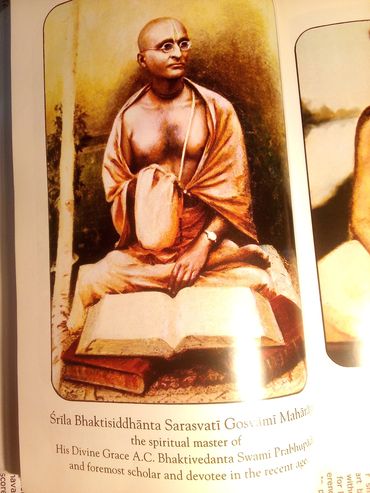
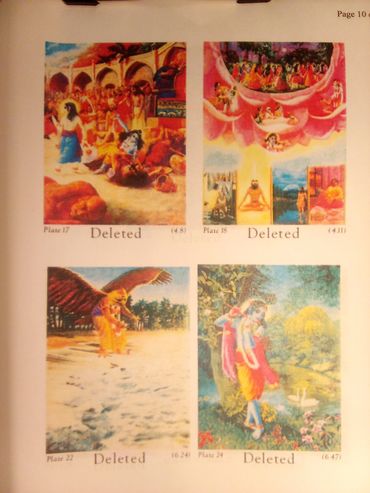
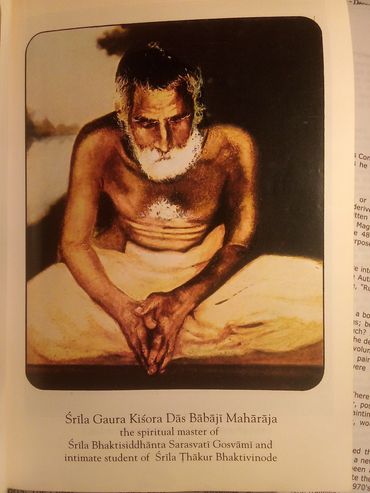
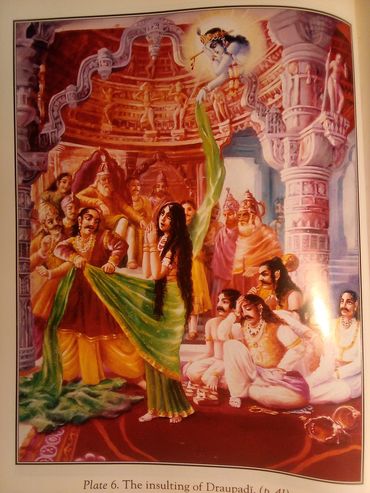
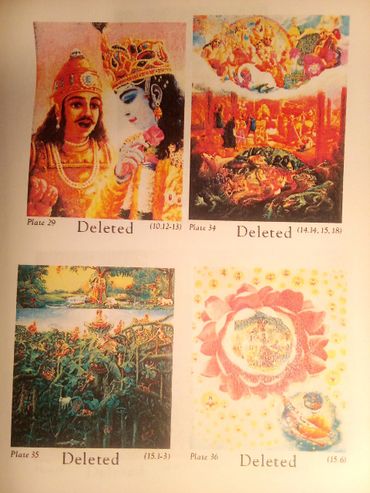
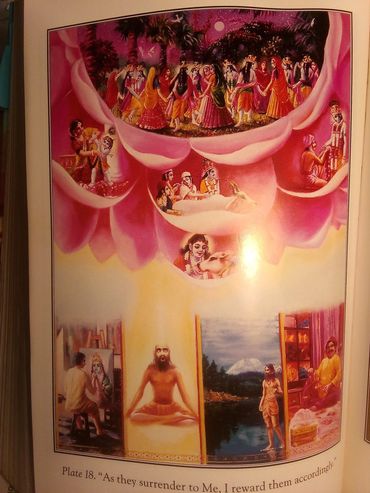
A FEW of the many pictures of the approved Complete Edition, now missing in the adulterated Gita, which Srila Prabhupada ordered must never be remove
Site Content
Additional Information
This is a long form text area designed for your content that you can fill up with as many words as your heart desires. You can write articles, long mission statements, company policies, executive profiles, company awards/distinctions, office locations, shareholder reports, whitepapers, media mentions and other pieces of content that don’t fit into a shorter, more succinct space.
Articles – Good topics for articles include anything related to your company – recent changes to operations, the latest company softball game – or the industry you’re in. General business trends (think national and even international) are great article fodder, too.
Mission statements – You can tell a lot about a company by its mission statement. Don’t have one? Now might be a good time to create one and post it here. A good mission statement tells you what drives a company to do what it does.
Company policies – Are there company policies that are particularly important to your business? Perhaps your unlimited paternity/maternity leave policy has endeared you to employees across the company. This is a good place to talk about that.
Executive profiles – A company is only as strong as its executive leadership. This is a good place to show off who’s occupying the corner offices. Write a nice bio about each executive that includes what they do, how long they’ve been at it, and what got them to where they are.
Learn More
This is a content preview space you can use to get your audience interested in what you have to say so they can’t wait to learn and read more. Pull out the most interesting detail that appears on the page and write it here.
ALL GLORIES TO SRILA PRABHUPADA!: hi
Copyright © 2023 Rupanugadas '66 ACBSP - All Rights Reserved.
COMMENTS & INQUIRIES WELCOME
This website uses cookies.
We use cookies to analyze website traffic and optimize your website experience. By accepting our use of cookies, your data will be aggregated with all other user data.